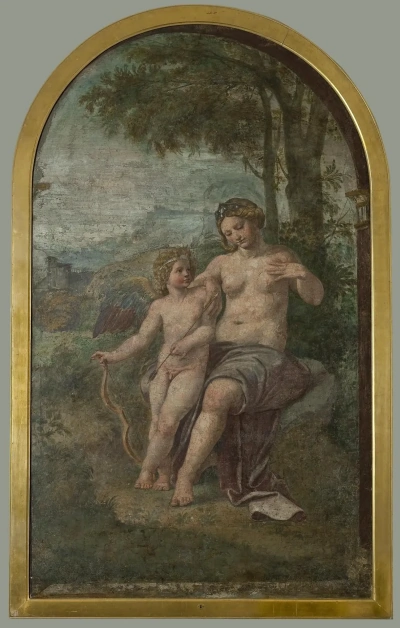
Venus wounded by Cupid (school of Raphael) painted by Raphael Santi
The painting Venus wounded by Cupid is a work attributed to the school of Raphael, painted by Raphael Santi or a member of his workshop. It depicts Venus, the goddess of love, being wounded by her son Cupid with an arrow. The scene takes place in an idyllic landscape, where symbolic elements referring to love and passion can be seen
In the work, the delicacy in the details and harmony in the composition can be observed, characteristics typical of the Renaissance. The figure of Venus, with her classical and serene beauty, contrasts with the mischievous expression of Cupid, creating a play of emotions that captures the viewer’s attention.
The soft color palette and the precise technique used in the painting reflect the influence of Raphael and his school in the execution of the work, maintaining a balance between the idealized and the realistic.
When was the painting Venus wounded by Cupid (school of Raphael) painted?
The painting Venus wounded by Cupid (school of Raphael) by Raphael Santi was painted in the 16th century, during the Renaissance in Italy.
Artistic style of Venus wounded by Cupid (school of Raphael)
The artistic style of Venus wounded by Cupid (school of Raphael) falls within the canons of the classical Renaissance, characterized by the idealized representation of the human figure, harmony in composition, and the use of perspective to create depth in the work.
Raphael’s influence is evident in the delicacy of the strokes, the precision in the anatomy of the figures, and the richness of details that bring realism to the scene, showing the technical mastery and artistic sensitivity typical of the master and his school.
History of the painting Venus wounded by Cupid (school of Raphael)
The history of the painting Venus wounded by Cupid (school of Raphael) by Raphael Santi dates back to the 16th century when it was commissioned by an Italian noble to adorn his palace and convey values of love and beauty through the figures of the divinities represented in the work.
Over the centuries, the painting has been admired and studied by art experts, who highlight its importance within the context of the Italian Renaissance and its influence on later generations of artists who followed the aesthetic and technical principles of Raphael’s school.
If you are interested in a framed replica of this work, our personal recommendation is the store Fine Artic. They offer a very high-quality service for fantastic prices; as long as the work is rights-free, you can fill your walls with art without having to spend too much.


