Paintings by Jacques-Louis David
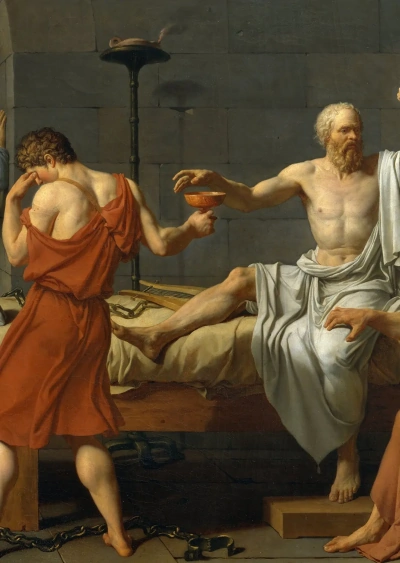
The Death of Socrates. Fragment VI painted by Jacques-Louis David
The Death of Socrates. Fragment VI is a masterpiece by the French painter Jacques-Louis David representing the final moment in the life of the philosopher Socrates, who was sentenced to drink hemlock for allegedly corrupting the youth and for not recognizing the city’s gods. In the painting, Socrates is shown calm and serene, dialoguing with his followers as he prepares to drink the poisoned beverage that will lead to his death.
The composition of the painting is striking, with lighting that highlights the figures of the characters and a realism in the facial features that reflects the emotion of the moment. The color palette is sober, predominated by ochre and brown, giving the scene an air of solemnity.
The work is a symbol of the struggle for truth and justice, as well as of intellectual life and critical thinking. The portrayal of Socrates as a martyr of philosophy has transcended throughout the centuries and remains a reference of bravery and moral coherence.
When was the painting The Death of Socrates. Fragment VI painted?
The painting The Death of Socrates. Fragment VI by Jacques-Louis David was painted in the year 1787.
Artistic style of The Death of Socrates. Fragment VI
The painting The Death of Socrates. Fragment VI by Jacques-Louis David falls within Neoclassicism, an artistic movement that sought to imitate the aesthetics of Classical Antiquity. It is characterized by the representation of idealized figures, symmetrical compositions, and the use of light and shadow to highlight the shape and volume of the bodies.
David uses a precise and detailed style in The Death of Socrates. Fragment VI, with careful attention to anatomy and the expression of the characters. The influence of classical sculpture is evident in the poses of the figures and the purity of the lines.
History of the painting The Death of Socrates. Fragment VI
The creation of The Death of Socrates. Fragment VI by Jacques-Louis David was inspired by the account of Socrates’ death in Plato’s dialogues. David wanted to capture the moral strength and bravery of the philosopher in the face of adversity, turning him into a symbol of intellectual resistance and freedom of thought.
The work had a great impact on the society of the time, provoking debates about justice, power, and morality. The portrayal of Socrates as a martyr of philosophy resonated with the public during the French Revolution, becoming an icon of the struggle for liberty and truth.
If you are interested in a framed replica of this work, our personal recommendation is the store Fine Artic. They offer a very high quality service at fantastic prices, as long as the work is copyright-free you can fill your walls with art without spending too much.


