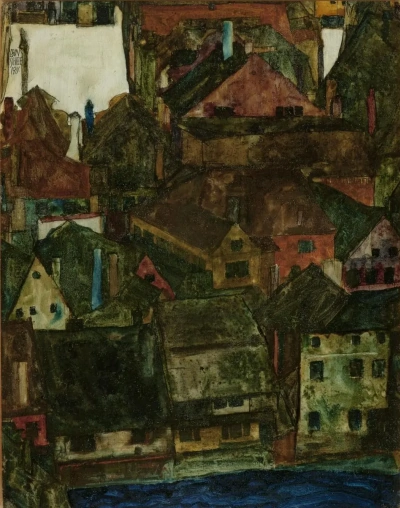
The painting Dead City of Cesky Krumlov painted by Egon Schiele
Egon Schiele, an Austrian artist known for his expressionist style, created the work Dead City of Cesky Krumlov as part of his series of landscapes in 1910. This painting represents a unique and disturbing vision of the Czech city, where Schiele experiments with the distortion of forms and colors to create an unsettling atmosphere.
In Dead City of Cesky Krumlov, Schiele uses loose brushstrokes and dark colors to convey a feeling of desolation and melancholy. The chaotic composition and absence of human figures reinforce the idea of an abandoned and forgotten place. The choice of Cesky Krumlov as a subject shows Schiele’s preference for less conventional places filled with history.
The work is characterized by the tension between realistic representation and the artist’s subjective interpretation, creating a surreal and mysterious atmosphere that invites the viewer to reflect on the fleeting nature of life and the inevitable decay of human structures.
When was the painting Dead City of Cesky Krumlov painted?
The painting Dead City of Cesky Krumlov was painted by Egon Schiele in 1910.
Artistic style of Dead City of Cesky Krumlov
The artistic style of Dead City of Cesky Krumlov is framed within expressionism, characterized by a subjective and emotional representation of reality. Schiele uses intense colors and distorted forms to express his unique and provocative vision, challenging the aesthetic conventions of his time.
Schiele’s work moves away from mere reproduction of reality to explore the depths of the human soul and the complexities of existence. His bold and provocative style has left an indelible mark on art history, influencing subsequent generations of artists.
History of the painting Dead City of Cesky Krumlov
The painting Dead City of Cesky Krumlov by Egon Schiele is one of his most enigmatic and evocative works, reflecting his fascination with dark and melancholic landscapes. The creation of this work was marked by the artist’s intense search to capture the essence of an abandoned and desolate place, where human presence is perceived only through empty structures and the shadows surrounding them.
The impact of Dead City of Cesky Krumlov goes beyond its visual representation, provoking in the viewer a deep reflection on the fragility of life and the fleeting nature of civilizations. Schiele’s work has become a reference of expressionism and continues to captivate those who delve into his enigmatic and disturbing universe.
If you are interested in a framed replica of this work, our personal recommendation is the store Fine Artic. They offer a very high-quality service at fantastic prices, as long as the work is royalty-free you can fill your walls with art without spending too much.


