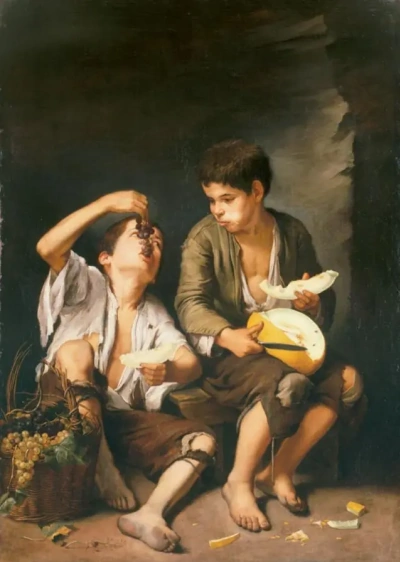
Introduction to “Children Eating Melon and Grapes” by Bartolomé Esteban Murillo
The painting “Children Eating Melon and Grapes” is one of the most emblematic and recognized works of Spanish art, created by the painter Bartolomé Esteban Murillo. This work stands out for its ability to capture the innocence and essence of youth through a simple yet deeply emotional scene. Murillo, a master of the Spanish Baroque, uses here his characteristic handling of light and shadow to bring life and texture to the composition.
The scene shows a group of children in a daily moment, enjoying the simplicity and pleasure of eating fruit. Through this representation, Murillo not only offers a detailed glimpse into the lives of children of his time but also conveys a universal message about joy and brotherhood. The attention to detail in the characters’ expressions and the use of vivid colors enhance the realism and warmth of the work.
Finally, this work is a faithful reflection of Murillo’s interest in social themes. Through the faces and gestures of the children, the artist manages to communicate feelings of satisfaction, companionship, and simplicity—elements that invite the viewer to reflect on the small joys of life.
When was the painting “Children Eating Melon and Grapes” painted?
The painting “Children Eating Melon and Grapes” was painted by Bartolomé Esteban Murillo around the 17th century, without being able to specify the exact year within that century.
Artistic style of “Children Eating Melon and Grapes”
The artistic style of “Children Eating Melon and Grapes” is clearly identifiable within the Spanish Baroque, a movement characterized by its treatment of light and shadow, also known as tenebrism, along with an emotional and detailed realism. Murillo, one of the greatest exponents of this period, demonstrates his ability to create works of great expressiveness and beauty.
In this work, Murillo uses a warm color palette that contributes to the feeling of intimacy and closeness with the characters. The play of light and shadow not only enhances the three-dimensionality of the composition but also emphasizes the texture of the food and the children’s skin. This technique highlights the naturalness and humanity of the scene, key elements of the Baroque.
Additionally, the composition of the work reveals an exquisite balance between detail and abstraction, where every brushstroke contributes to the narrative and emotionality of the piece. Murillo manages to capture the essence of childhood and brotherhood with a mastery that transcends time and continues to move the contemporary viewer.
History of the painting “Children Eating Melon and Grapes”
The history behind “Children Eating Melon and Grapes” by Bartolomé Esteban Murillo is enveloped in the admiration and value it has accumulated through the centuries. Since its creation in the 17th century, this painting has been the subject of study and appreciation by experts and art enthusiasts alike. The work has traveled through different collections and museums, witnessing the change of perceptions about Baroque art and Murillo in particular.
Its cultural impact is significant, as it has served as a source of inspiration for other artists and has contributed to building a collective imagery around childhood and everyday life in the Spanish Baroque. Beyond its unquestionable beauty and technique, “Children Eating Melon and Grapes” remains an important testimony of the society of its time and a reminder of the small pleasures of life, themes that continue to be relevant today.
If you are interested in a framed replica of this work, our personal recommendation is the store Fine Artic. They offer a very high-quality service at fantastic prices; as long as the work is rights-free, you can fill your walls with art without having to spend too much.


