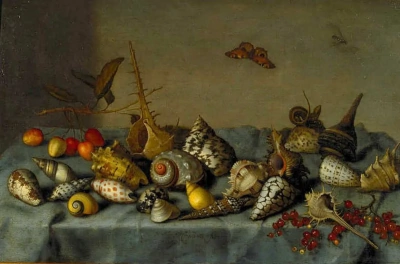
About the painting Still Life with Shells by Balthasar van der Ast
El cpainting Still Life with Shells, painted by Balthasar van der Ast, is a work that captures attention due to its astonishing detail and the artist’s skill in portraying different textures and sensations. This painting represents not only a variety of sea shells arranged artistically, but also includes additional elements that enrich the composition and add an extra layer of meaning and beauty to the piece.
Van der Ast was known for his ability to recreate the beauty of still life, and in this painting, his skill is evident in every brushstroke. Light and shadow play a crucial role, highlighting the intricate shapes and colors of the shells and other present elements. The arrangement of these objects is not random; each seems to have a specific place within the canvas, creating an impressive visual and thematic balance.
This painting is not only a visual feast but also serves as a testament to the interest and fascination with the natural world that prevailed during the period it was created. Through this work, Balthasar van der Ast manages to transport us to an environment full of calm, beauty, and a deep appreciation for the small details of the natural world.
When was the painting Still Life with Shells painted?
The painting Still Life with Shells by Balthasar van der Ast was painted in the first half of the 17th century.
Artistic style of Still Life with Shells
The artistic style of the Still Life with Shells falls within the Baroque, especially in the tradition of the 17th-century Dutch still life. This movement was characterized by an emphasis on detail, realism, and often, rich symbolism that transcended the simple depiction of everyday objects.
In Van der Ast’s work, this preference for detail is manifested in the almost scientific precision with which shells and other natural elements are represented. The light, meticulously applied, not only highlights the intrinsic beauty of these objects but also creates an atmosphere of tranquility and reflection.
Moreover, the use of space and composition in the painting show an intentionality behind every element included in the work. This is not a mere exercise in representation but a deep exploration of the relationship between man and nature, a recurring theme in Baroque art. Through this work, Van der Ast contributes significantly to the evolution of still life, endowing it with notable thematic complexity and depth.
History of the painting Still Life with Shells
El Still Life with Shells not only stands out for its technical virtuosity but also for the history surrounding it. Balthasar van der Ast was one of the pioneers in still life painting in the Netherlands, a tradition that later expanded across Europe. His focus on sea shells is set within a context of growing interest in exploration and scientific collecting during the 17th century. Shells were valued not only for their beauty but also as objects of study and status symbols.
The influence of this type of work was considerable, extending beyond the borders of art to influence the fields of science and collecting. The Still Life with Shells and similar works played a key role in the development of cabinets of curiosities and in promoting marine scientific research. Today, this painting is appreciated not only for its artistic quality but also as a testament to humanity’s insatiable curiosity about the natural world and its desire to understand, classify, and appreciate the vast diversity of life on Earth.
If you are interested in a framed replica of this work, our personal recommendation is the store Fine Artic. They offer a very high-quality service at fantastic prices, and as long as the work is rights-free, you can fill your walls with art without having to spend too much.


