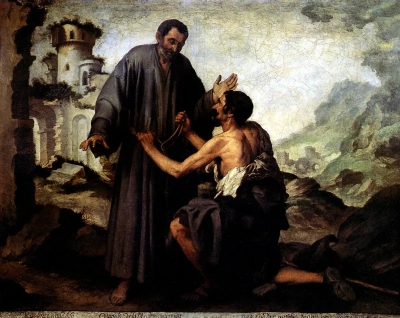
Brother Junípero and the Beggar by Bartolomé Esteban Murillo
The painting Brother Junípero and the Beggar, a work by Bartolomé Esteban Murillo, is a moving representation of Christian charity. In this piece, Murillo captures the moment when the Franciscan friar, Brother Junípero, is about to help a beggar. The interaction between these two central figures leads viewers to reflect on compassion and humility.
The scene is set in an everyday environment, which makes the painting’s message even more accessible to the audience of the time. The warm colors and soft lighting contribute to an atmosphere of hope and benevolence. This work stands out for Murillo’s skill in conveying emotions and moods through his brushes.
The attention to detail in the expressions and body language of the figures reflects Murillo’s mastery as a Spanish Baroque painter. It is an invitation to contemplate not only the beauty of the work but also its profound humanist message.
When was the painting Brother Junípero and the Beggar painted?
The painting Brother Junípero and the Beggar by Bartolomé Esteban Murillo was painted in the second half of the 17th century, although the exact year cannot be specified.
Artistic style of Brother Junípero and the Beggar
The painting Brother Junípero and the Beggar is a representative example of Spanish Baroque, characteristic of the work of Bartolomé Esteban Murillo. This style is distinguished by its focus on the expression of emotions, the intense use of light and shadow, and a preference for religious and everyday themes presented in an idealized manner.
Murillo uses chiaroscuro techniques to give depth to the scene and highlight the figures of Junípero and the beggar. The balanced composition, together with a palette of warm colors, contributes to the immediate empathy the work evokes in the viewer. Murillo’s painting technique achieves an impressive harmony between realism and idealization.
Additionally, the tendency to capture natural light and its effect on surfaces and textures is a signature of the artist. This approach not only enhances the aesthetic quality of the painting but also intensifies its emotional weight, making the message of compassion resonate more strongly in the hearts of those who behold it.
History of the painting Brother Junípero and the Beggar
Despite the lack of specific records about the exact context of its creation, it is known that Brother Junípero and the Beggar was part of Murillo’s artistic production framed in 17th-century Seville, a period during which the artist created several works with religious themes. The choice of everyday characters and settings aimed not only to adorn altarpieces and sacred spaces but also to bring Christian teachings closer to the population.
The impact of the work transcends the aesthetic and delves into the social and educational. By depicting charity in such a direct and emotional way, Murillo not only demonstrated his skill in capturing the essence of the human spirit but also promoted, through art, values of compassion and humility among the faithful and spectators of his time. Thus, the painting has become an enduring testimony to the richness of Spanish Baroque and its capacity to communicate transcendental messages.
If you are interested in a framed replica of this work, our personal recommendation is the store Fine Artic. They offer a very high-quality service at fantastic prices, and as long as the work is copyright-free, you can fill your walls with art without spending too much.


