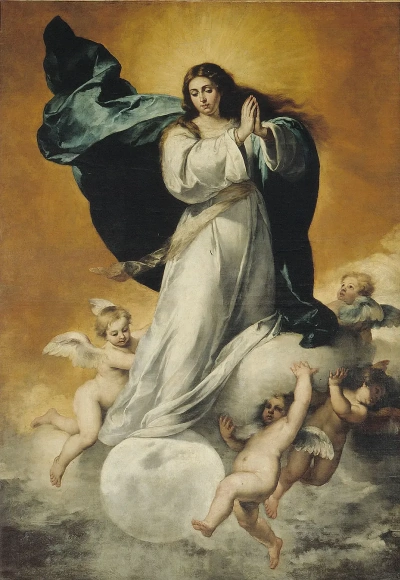
‘Immaculate Conception’ by Bartolomé Esteban Murillo
La ‘Immaculate Conception’ is a masterpiece by Bartolomé Esteban Murillo, one of the most outstanding painters of the Spanish Baroque. This painting fervently reflects the purity and holiness of the Virgin Mary, concepts deeply rooted in the Catholic spirituality of the time. Murillo, with his brush, manages to capture the essence of the divine, enveloping the central figure in an atmosphere of light and heavenly peace.
The depiction of Mary as a young woman of immaculate beauty, surrounded by a series of angels and clouds, symbolizes her spotlessness. Murillo’s technique acquires a transcendental dimension, where the play of chiaroscuro, along with a palette of soft colors, reinforces the message of innocence and divinity. This work not only demonstrates the artist’s technical mastery but also his ability to infuse deep emotions in the viewer.
Finally, the ‘Immaculate Conception’ stands out as an icon within religious art, representing not only the faith of an era but also Murillo’s high degree of personal devotion to the figure of the Virgin. It is, therefore, a key piece to understand the religiosity of the 17th century in Spain.
When was the ‘Immaculate Conception’ painting created?
The ‘Immaculate Conception’ painting by Bartolomé Esteban Murillo was painted in the second half of the 17th century.
Artistic style of ‘Immaculate Conception’
The artistic style of the ‘Immaculate Conception’ falls within the Baroque, a movement that dominated Europe during the 17th century. Murillo, in particular, is recognized for his ability to endow his works with an almost divine sweetness and luminosity, traits very present in this piece. The technique used to depict the Virgin Mary and the light effects stand out for conveying a sense of purity and spiritual elevation.
In the ‘Immaculate Conception,’ Murillo uses a palette of light and vivid colors that contrast with the dark background, a technique that highlights the figure of the Virgin, enhancing her symbolic and spiritual importance. This masterful handling of light and shadow, typical of Baroque, serves to create an effect of three-dimensionality and volume, giving the scene palpable realism.
The harmonious composition and the expressiveness of the characters, characteristic elements of Murillo’s art, make the ‘Immaculate Conception’ a clear example of his mastery and contribution to Spanish Baroque. The work undoubtedly reflects the artist’s skill in merging the earthly world with the spiritual, achieving a perfect balance between both.
History of the ‘Immaculate Conception’ painting
The ‘Immaculate Conception’ by Bartolomé Esteban Murillo is significant not only for its beauty and artistic merit but also for its cultural and religious impact at the time. This work became one of the most emblematic and devout representations of the Virgin Mary, influencing Marian perception and worship within 17th-century Spanish society.
Additionally, the painting has had a notable historical trajectory, having been venerated, studied, and admired over the centuries. The depth of its impact lies not only in Murillo’s technical mastery but also in his ability to convey profound spirituality and devotion. Its transcendence crosses time, remaining a testament to the faith and art of its era.
If you are interested in a framed replica of this work, our personal recommendation is the store of Fine Artic. They offer a very high-quality service at fantastic prices; as long as the work is copyright-free, you can fill your walls with art without having to spend too much.


