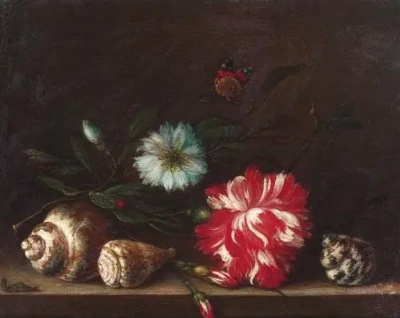
Carnations and shells on a stone table, by Balthasar van der Ast
The work “Carnations and shells on a stone table”, created by Balthasar van der Ast, is a spectacular example of the artist’s skill in capturing the intrinsic beauty of natural objects. In this painting, van der Ast masterfully combines floral and marine elements, creating a composition rich in detail and symbolism. The carnations, with their variety of colors and shapes, are juxtaposed with the seashells meticulously selected, both resting on a stone surface.
The attention to detail is evident in every inch of the work, from the texture of the carnation petals to the precision in the drawing of the shells. The arrangement of elements within the composition reveals not only a keen sense of balance and harmony but also a deep knowledge of the subject by the artist. This painting is a testament to van der Ast’s love for naturalism and his ability to immortalize the ephemeral beauty of nature on canvas.
Beyond its aesthetic beauty, the painting invites reflection on the relationship between man and nature and the desire to preserve its unsurpassed splendor. Through this work, van der Ast not only celebrates the beauty of nature but also invites us to contemplate our own connection with the natural world. The piece is a window into the artist’s unique vision and his ability to transform the everyday into something extraordinarily beautiful.
When was the painting Carnations and shells on a stone table painted?
The painting “Carnations and shells on a stone table” was painted during the first half of the 17th century.
Artistic style of Carnations and shells on a stone table.
The painting “Carnations and shells on a stone table” is a reflection of the master’s baroque style in its early phase, characterized by its detailed representation of natural objects and a masterful use of light and shadow to produce an effect of depth and surprising realism. Balthasar van der Ast was known for his detailing skill and technical precision, qualities evident in this work.
The influence of this style in the work can be seen in the intricate manner in which the elements are arranged, creating a feeling of abundance and luxury typical of the Baroque era. Additionally, the use of rich colors and varied textures adds a dimension of sensuality and tangible physical presence, key elements of the Baroque. This work exemplifies the effort to capture the reality of nature while simultaneously glorifying it, a common trend in the art of this period.
In conclusion, “Carnations and shells on a stone table” encapsulates the essence of early Baroque, emphasizing realism, compositional complexity, and attention to detail. Van der Ast leverages these characteristics to invite the viewer to reflect on beauty and the transience of life, recurring themes in Baroque art.
History of the painting Carnations and shells on a stone table.
The work of Balthasar van der Ast, “Carnations and shells on a stone table”, stands out not only for its artistic quality but also for its unique history. Although specific details about the creation of this painting are scarce, it is known that van der Ast was a prominent figure in the 17th-century Dutch art circle, and his work reflects the flourishing of still life painting of the period. His preference for natural themes fits within a cultural context where there was growing interest in natural science and the cataloging of nature.
The impact of the work has transcended its time, becoming a source of inspiration for future generations of artists. Its meticulous attention to detail and ability to immortalize the fleeting beauty of everyday objects speaks of a profound appreciation for the natural world. This painting has been analyzed and admired for its contribution to the development of still life as a genre, especially valuing how van der Ast balances composition and handles light and shadow to infuse life and depth into inanimate objects.
If you are interested in a framed replica of this work, our personal recommendation is the store Fine Artic. They offer a very high-quality service at fantastic prices, as long as the work is copyright-free you can fill your walls with art without needing to spend too much.


