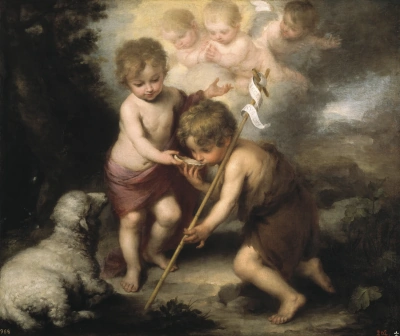
The Painting “Children” by Bartolomé Esteban Murillo
The painting “Children” by Bartolomé Esteban Murillo depicts a tender and everyday scene, where the little protagonists are shown engaged in typical childhood activities and gestures. Murillo, known for his ability to capture innocence and beauty in his works, achieves in “Children” a vivid and emotional representation that transcends time. The details, the luminosity and the expressiveness of the faces are some of the most prominent elements.
This canvas evokes a feeling of nostalgia and purity. Through the interaction of the children, Murillo not only demonstrates his mastery of technique but also his deep understanding of child psychology. The composition of the painting, where the characters seem immersed in their own world, reinforces the idea of an idyllic childhood, free from adult concerns.
Moreover, the use of color and light play a crucial role in the work. Murillo employs these elements to emphasize the theme of innocence and to direct the viewer’s gaze toward the central figures. The palette of soft colors contributes to the atmosphere of serenity and harmony that characterizes this painting.
When was the painting Children painted?
The painting “Children” by Bartolomé Esteban Murillo was painted during the Baroque period, although the exact year of its creation cannot be specified.
Artistic style of Children
The artistic style of the painting “Children” is framed within the Baroque, characterized by the dramatic use of color and light, as well as by the detailed and realistic representation of human figures. Murillo especially stands out in his treatment of light, using it to create a warm and welcoming atmosphere that envelops the characters and highlights their innocence.
In the work, the composition plays a crucial role in the visual narrative. Murillo arranges the characters so that each contributes to the overall story, without any one standing out individually. This technique demonstrates the painter’s ability to tell stories through his paintings, creating an emotional connection with the viewer.
Finally, realism and attention to detail are significant elements of Murillo’s style in “Children.” The precision in executing facial expressions and the textures of clothing show his mastery and commitment to faithfully representing reality, aspects that make him one of the most prominent exponents of the Spanish Baroque.
History of the painting Children
The history of the painting “Children” by Bartolomé Esteban Murillo is not only the story of an artwork but also a reflection of the era in which it was created. Murillo, active during the Spanish Golden Age, lived at a time when art was used both for religious purposes and to portray the everyday life of society at that time. Although the painting itself is not laden with specific anecdotes about its creation, its existence is a testament to Murillo’s versatility and skill in capturing the essence of humanity through the eyes of children.
Its impact, both on contemporaries and future generations, has been profound. The ability to convey the universality of human emotions, particularly the innocence and joy of childhood, has made the painting “Children” one of Murillo’s most celebrated works. Additionally, it has served as inspiration for numerous artists over the centuries, keeping Murillo’s legacy alive and ensuring that his interpretation of life and humanity continues to resonate in the art world.
If you are interested in a framed replica of this work, our personal recommendation is the store Fine Artic. They offer a very high-quality service at fantastic prices, and as long as the work is copyright-free you can fill your walls with art without needing to spend too much.


