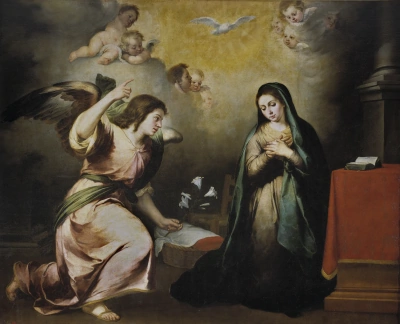
The Nativity of Mary by Bartolomé Esteban Murillo
The work The Nativity of Mary is an artistic representation that captures the piety and inherent beauty of a significant spiritual moment. Painted by the renowned Spanish artist Bartolomé Esteban Murillo, this painting expresses the tenderness and sacredness of the birth of the Virgin Mary with undisputed mastery. Murillo, through his brush, invites us to contemplate a divine episode, enveloping it in an atmosphere of serenity and light.
The composition shows several characters in an intimate and religious scene, highlighting the figure of the newborn, surrounded by affection and devotion. The attention to detail in facial expressions and body postures is evident, conveying the deep emotions of those present. Murillo uses light masterfully, focusing it on the Virgin Mary, which not only accentuates her importance but also contributes to the feeling of divinity and purity of the moment.
The palette of soft and harmonious colors complements the painter’s intention to offer a heavenly vision. Pastel tones and the way light diffuses through the scene bring a sensitivity and delicacy characteristic of Murillo’s work, making The Nativity of Mary an emblematic piece of his vast artistic legacy.
When was the painting The Nativity of Mary created?
The painting The Nativity of Mary by Bartolomé Esteban Murillo was painted in the second half of the 17th century.
Artistic style of The Nativity of Mary
The artistic style of the painting The Nativity of Mary is a clear example of the Baroque, a movement that dominated European art of the time. Murillo, as one of the most outstanding representatives of the Spanish Baroque, incorporates in this work the main characteristics of this style: the dramatization of the scene, the intensive use of light and shadow (tenebrism) to create depth and volume, and meticulous attention to the emotional and physical details of the characters.
The way Murillo captures the divine light illuminating the Virgin Mary and his skillful use of soft coloring are distinctive elements that enrich the religious and emotional content of the piece. This work reflects the artist’s ability to convey both humanity and divinity, blending them in a beautifully balanced composition.
Furthermore, the painting displays expressiveness and warmth that invite spiritual reflection. Through these elements, Murillo not only communicates the importance of the sacred event but also establishes an emotional connection with the viewer, demonstrating his mastery in handling the technical and narrative aspects of Baroque art.
History of the painting The Nativity of Mary
The creation of The Nativity of Mary by Bartolomé Esteban Murillo is set in a historical context where religious art played a crucial role in devotion and spiritual education of society. Like many of Murillo’s works, this painting was likely commissioned by a religious institution or a private devotee, aiming to inspire faith and contemplation through art. The choice of subject reflects the strong Marian devotion of Spanish Catholicism at the time, highlighting Mary’s importance as a pious figure and mother of Jesus Christ.
Over the years, The Nativity of Mary has transcended its original context to become an object of global admiration, showing Murillo’s impact beyond Spanish borders. His ability to capture the essence of the divine and the human has resonated in different cultures and eras, securing its place in art history as a work that continues to inspire generations through its intrinsic beauty and spiritual richness.
If you are interested in a framed replica of this work, our personal recommendation is the store of Fine Artic. They offer a very high-quality service at fantastic prices, and as long as the work is free of rights, you can fill your walls with art without spending too much.


