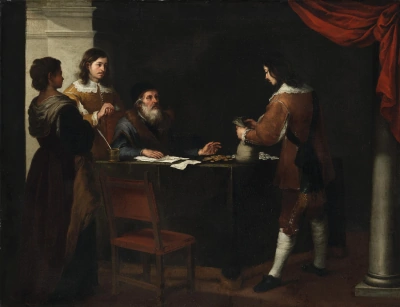
The painting The Prodigal Son by Bartolomé Esteban Murillo
The painting The Prodigal Son by Bartolomé Esteban Murillo is a vivid representation of one of the best-known parables from the New Testament. The work details the journey of a young man who, after squandering his inheritance, returns repentant to his father’s home. Murillo uses his skill to capture human emotions, bringing the biblical narrative to life on the canvas.
The expressions and body language of the protagonists are especially notable, showing forgiveness and redemption through the subtle yet impactful details that Murillo masterfully handles. This work is not only a study of emotions and human relationships but also a testament to the artist’s narrative skill.
The use of light and color plays a crucial role in The Prodigal Son, where Murillo demonstrates his expertise in creating an atmosphere that perfectly reflects the tone of the story. The soft palette and interplay of light not only beautify the work but also accentuate the emotional and spiritual depth of the narrative.
When was the painting The Prodigal Son created?
The painting The Prodigal Son by Bartolomé Esteban Murillo was painted in the second half of the 17th century.
Artistic style of The Prodigal Son
The artistic style of The Prodigal Son belongs to the Baroque, a movement characterized by its drama, emotional realism, and prominent use of light and shadow. Murillo, being one of the most notable exponents of the Spanish Baroque, employs these techniques to evoke deep empathy in the viewer towards the narrative of redemption and forgiveness.
The composition of the work shows careful attention to detail and spatial organization, elements Murillo uses to guide the viewer’s gaze through the narrative. The contrast between light and shadow, along with the choice of colors, highlights the emotional depth of the scene, following the Baroque aesthetic of moving the spectator.
Finally, in The Prodigal Son, Murillo’s skill in capturing the texture and material of the garments and objects adds an additional layer of realism to the work. This aspect, combined with the expression of the characters and the use of light, contributes to the viewer’s immersion in the story, showcasing Murillo’s mastery of the Baroque style.
History of the painting The Prodigal Son
The creation of The Prodigal Son takes place within a context where artworks not only had a decorative or aesthetic purpose but also sought to teach moral and religious values. In this sense, Murillo not only executes an exceptional technical work but also fulfills the commission to convey a spiritual and redemptive message to his audience.
The impact of The Prodigal Son transcends its era, becoming a reference within art history for the representation of human emotions and universal values. Murillo’s ability to connect with the viewer through narrative and technical mastery has ensured that this work remains relevant, studied, and admired centuries after its creation.
If you are interested in a framed replica of this work, our personal recommendation is the store Fine Artic. They offer a very high-quality service at fantastic prices, and as long as the artwork is copyright-free, you can fill your walls with art without spending too much.


