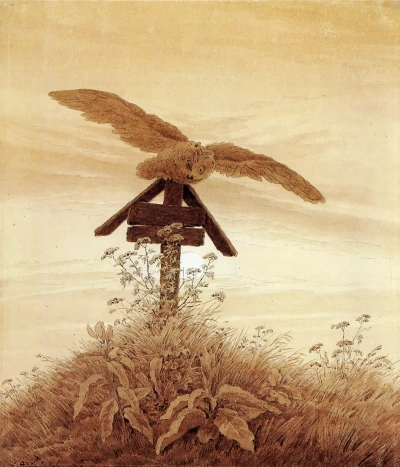
The painting “Owl on the Grave” by Caspar David Friedrich
Owl on the Grave is an iconic work by the German painter Caspar David Friedrich. In this painting, one can appreciate the depiction of an owl resting on a grave in a mysterious and melancholic landscape.
The image of the owl, a symbol of wisdom and mystery, contrasts with the somber and solitary atmosphere that surrounds the scene. The grave, the central element of the composition, suggests the presence of death and the transience of life.
With a palette of dark colors and somber tones, Friedrich manages to convey a sense of nostalgia and reflection, inviting the viewer to enter a symbolic world filled with meaning.
When was the painting Owl on the Grave painted?
The painting “Owl on the Grave” by Caspar David Friedrich was painted in the year 1836 during the period known as Romanticism.
Artistic style of Owl on the Grave
The artistic style of “Owl on the Grave” falls within Romanticism, characterized by the exaltation of nature, the exploration of the supernatural, and the expression of emotions and moods.
Friedrich manages to blend realistic elements with symbolism, creating compositions full of mysticism and meaning. His attention to detail and his ability to convey solitude and melancholy make him one of the most prominent representatives of German Romanticism.
History of the painting Owl on the Grave
The work “Owl on the Grave” by Caspar David Friedrich has sparked various interpretations over the years, being considered a reflection on life, death, and the transcendence of the human being. Its aesthetic and emotional impact has made it a fundamental piece of Romantic art, inspiring generations of artists and art lovers.
If you are interested in a framed replica of this work, our personal recommendation is the store Fine Artic. They offer a very high-quality service at fantastic prices; as long as the work is copyright-free, you can fill your walls with art without spending too much.


