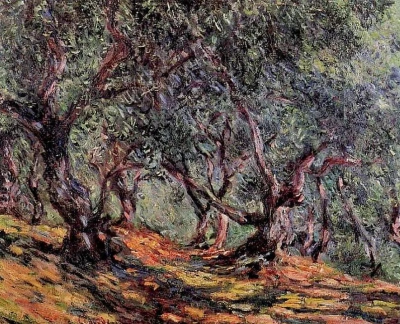
Olives in Bordighera by Claude Monet
Olives in Bordighera is a work by the famous impressionist painter Claude Monet. It was painted during his stay in Bordighera, Italy, where he captured the beauty of nature and the light of the place in his brushstrokes.
In this painting, Monet shows us a colorful and vibrant landscape, with a foreground of olive branches heavy with olives and a background of palm trees and the Mediterranean Sea. The artist’s impressionist technique is reflected in the loose brushwork and in the way the light filters through the trees.
The color palette used by Monet in Olives in Bordighera is characteristic of his impressionist style, with bright and vivid tones that create a sense of movement and life in the painting.
When was the painting Olives in Bordighera painted?
The painting Olives in Bordighera by Claude Monet was painted in the year 1884, during his stay in Bordighera, Italy.
Artistic style of Olives in Bordighera
The artistic style of Olives in Bordighera fits within Impressionism, characterized by the spontaneous and fleeting depiction of light and color. In this work, Monet uses loose brushstrokes and vibrant colors to capture the essence of the Italian landscape.
History of the painting Olives in Bordighera
The work Olives in Bordighera by Claude Monet was created during his trip to Italy in search of inspiration. It is said that the artist was fascinated by the beauty of Bordighera and decided to capture it on canvas through this painting. Its impact on art history lies in its contribution to the impressionist movement and in the way it uniquely captured light and color.
If you are interested in a framed replica of this work, our personal recommendation is the store Fine Artic. They offer a very high-quality service at fantastic prices, and as long as the artwork is copyright-free, you can fill your walls with art without spending too much.


