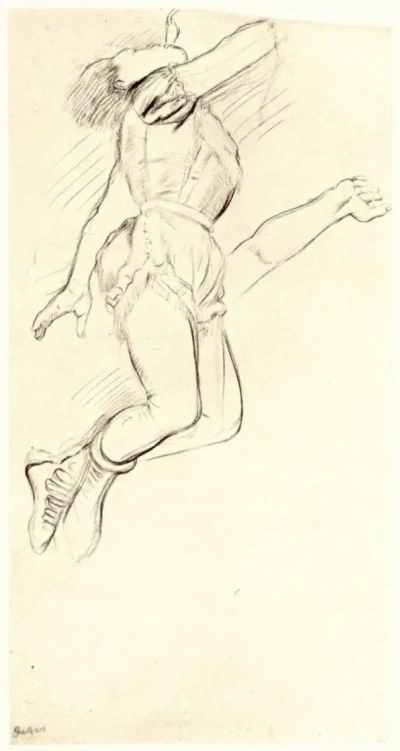
The painting Miss La La, holding onto the trapeze with her teeth. Sketch painted by Edgar Degas
Miss La La, holding onto the trapeze with her teeth is a sketch painted by the French artist Edgar Degas. The work shows an acrobat holding onto the trapeze with her teeth, in an impressive display of strength and skill.
The painting captures a unique and challenging moment in the acrobat’s life, showing the tension and concentration necessary to perform such a feat. Degas masterfully depicts the grace and physical dexterity of the circus performer.
The work reflects Degas’s fascination with figures in motion and the world of entertainment, recurring themes in his work. Although it is a sketch, the painting conveys the energy and emotion of the moment represented.
When was the painting Miss La La, holding onto the trapeze with her teeth. Sketch painted?
The painting Miss La La, holding onto the trapeze with her teeth. Sketch by Edgar Degas was painted in the 1870s.
Artistic style of Miss La La, holding onto the trapeze with her teeth. Sketch
The artistic style of Miss La La, holding onto the trapeze with her teeth. Sketch by Edgar Degas fits within Impressionism, characterized by the representation of light and movement, as well as capturing everyday scenes and fleeting moments.
Degas uses loose brushstrokes and a vibrant color palette to create a sense of dynamism and life in the work. His focus on the human figure in motion reflects his interest in exploring expression and emotion through art.
History of the painting Miss La La, holding onto the trapeze with her teeth. Sketch
The sketch of Miss La La, holding onto the trapeze with her teeth by Edgar Degas was created during a period when the artist was deeply engaged in observing the circus world. Degas was influenced by the vitality and energy of circus performers, which he captured in several of his works.
The creation of this sketch may have been inspired by Degas’s visit to a circus or by observing acrobats in action. The work stands out for its unique depiction of strength and physical skill, as well as the artist’s ability to capture fleeting, emotion-filled moments.
If you are interested in a framed replica of this work, our personal recommendation is the store Fine Artic. They offer a very high-quality service at fantastic prices; as long as the work is copyright-free, you can fill your walls with art without needing to spend too much.


