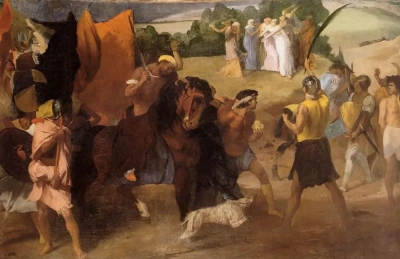
The Daughter of Jephthah by Edgar Degas
The Daughter of Jephthah is a painting by the famous French artist Edgar Degas, which depicts a biblical scene full of drama and emotion.
In the work, Degas portrays the daughter of Jephthah, a character from the Old Testament, at the moment she discovers that her father has made a vow to God that obliges her to sacrifice her life.
The composition of the painting, with masterful use of light and shadow, as well as the expressiveness of the gestures and gazes of the characters, reflects Degas’s talent and sensitivity.
When was the painting The Daughter of Jephthah created?
The painting The Daughter of Jephthah by Edgar Degas was painted in 1859.
Artistic style of The Daughter of Jephthah
The Daughter of Jephthah by Edgar Degas features a realisticartistic style characterized by attention to detail and precise representation of the characters’ emotions.
The loose brushwork and subtle color palette contribute an atmosphere of melancholy and tragedy to the work, highlighting the narrative strength of the depicted scene.
History of the painting The Daughter of Jephthah
The Daughter of Jephthah by Edgar Degas is a work that has generated great interest and debate among art critics, who have emphasized its profound emotional content and visual impact.
Over the years, the painting has been subject to various interpretations and analyses, which have helped enrich its cultural and artistic value in the art world.
If you are interested in a framed replica of this work, our personal recommendation is the store Fine Artic. They offer a very high-quality service at fantastic prices; as long as the work is rights-free, you can fill your walls with art without spending too much.


