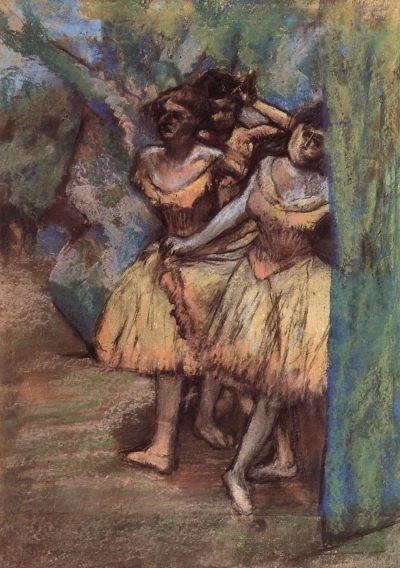
Three Dancers Backstage
Three Dancers Backstage is a work painted by the French artist Edgar Degas, which shows three ballet dancers preparing backstage before a performance. The painting captures the intimacy and delicacy of these moments before the show, displaying the concentration and grace of the dancers.
The soft tones and carefully crafted lighting by Degas create an intimate and serene atmosphere in the scene, highlighting the beauty and movement of the dancers. The symmetrical composition and attention to detail characterize the work, reflecting the artist’s mastery in depicting dance and motion.
Con Three Dancers Backstage, Degas invites us to enter the world of ballet, showing not only the elegance and grace of the dancers on stage but also the moments of preparation and focus behind the curtain.
When was the painting Three Dancers Backstage painted?
The painting Three Dancers Backstage by Edgar Degas was painted in 1888.
Artistic style of Three Dancers Backstage.
The work Three Dancers Backstage by Edgar Degas falls within the Impressionist movement, characterized by the depiction of everyday scenes and the capture of fleeting moments with loose and quick brushstrokes. Degas, although he did not consider himself an impressionist, shared with this group the pursuit of spontaneity and light in his works.
Degas’s painting stands out for its focus on representing movement and dance, as well as for its innovative use of perspective and composition. In Three Dancers Backstage, Degas manages to capture the grace and beauty of the dancers in an intimate and serene moment, showing his mastery in depicting the human figure in motion.
History of the painting Three Dancers Backstage.
The work Three Dancers Backstage by Edgar Degas was created during a period of intense artistic activity for the painter, who devoted much of his career to representing ballet scenes and everyday life in 19th-century Paris. This particular painting stands out for its delicacy and the attention to detail in depicting the dancers, showing Degas’s interest in capturing the elegance and grace of ballet.
The painting has been recognized for its beauty and carefully worked composition, becoming one of Degas’s most emblematic works. Its impact on art history has been significant, influencing later generations of artists and consolidating Degas’s reputation as one of the most important painters of Impressionism.
If you are interested in a framed replica of this work, our personal recommendation is the store Fine Artic. They offer a very high-quality service at fantastic prices; as long as the artwork is copyright-free, you can fill your walls with art without spending too much.


