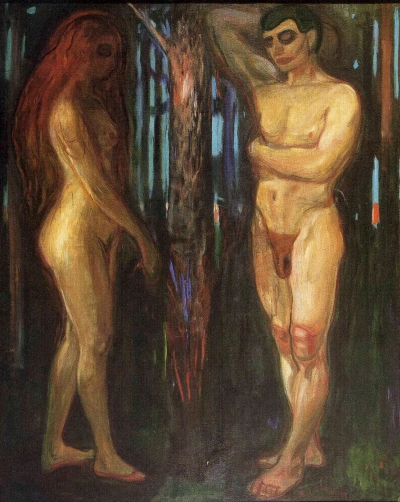
Adam and Eve by Edvard Munch
The painting Adam and Eve by Edvard Munch is a work that represents the first human beings according to biblical tradition. In the painting, a naked man and woman can be seen in a natural and paradisiacal setting. Munch uses warm colors and expressive brushstrokes to convey intense emotions in the piece.
The figure of Adam is shown with an upright posture and a serene gaze, while Eve appears more reclined and with a contemplative expression. The representation of the couple is characterized by the simplicity of forms and the absence of superfluous details, which gives the scene a timeless and universal character.
The composition of the work focuses on the connection between Adam and Eve, highlighting the intimacy and complementarity between both characters. Through the expressiveness of the figures and the use of symbolism, Munch manages to convey the duality between innocence and temptation.
When was the painting Adam and Eve painted?
The painting Adam and Eve by Edvard Munch was painted in the year 1909.
Artistic style of Adam and Eve
The artistic style of Adam and Eve by Edvard Munch is characterized by its symbolic and expressionist approach. Munch uses vibrant colors and emotive brushstrokes to represent the figures of Adam and Eve in a suggestive and evocative way. The combination of simple geometric forms and the absence of realistic details contribute to creating a mystical and timeless atmosphere in the work.
Munch’s work is part of the symbolism movement, where the aim is to represent abstract concepts through images with strong emotional and spiritual content. In Adam and Eve, Munch explores themes such as the duality between good and evil, innocence and temptation, through the representation of the primordial couple according to biblical tradition.
History of the painting Adam and Eve
The painting Adam and Eve by Edvard Munch was created during a period of intense artistic exploration by the Norwegian painter. The work reflects Munch’s fascination with human nature, spirituality, and symbolism, recurring themes in his artistic production. Through the representation of the biblical couple, Munch seeks to explore the complexity of human relationships and the inherent duality of human beings.
Adam and Eve by Edvard Munch has been a controversial work and has generated various interpretations throughout the history of art. The depiction of the naked human figure and the exploration of taboo themes such as sexuality and temptation have made this piece an emblematic work in Munch’s production and in the history of modern art.
If you are interested in a framed replica of this work, our personal recommendation is the shop Fine Artic. They offer a very high-quality service at fantastic prices, and as long as the work is royalty-free, you can fill your walls with art without spending too much.


