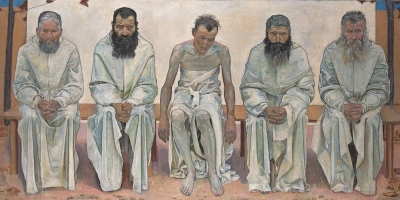
Painting “Tired of Life” by Ferdinand Hodler
The painting “Tired of Life” by Ferdinand Hodler is a work that represents melancholy and loneliness through the figure of an elderly man with white hair and beard, seated in a hunched position with a lost gaze and a deep sadness expression on his face.
The color palette used by Hodler in this work is mainly somber, with dark tones that help create an atmosphere of melancholy and desolation. The symmetrical composition and the absence of decorative elements reinforce the feeling of isolation and hopelessness conveyed by the painting.
The technique employed by Hodler in “Tired of Life” shows his ability to capture the complexity of human emotions through the facial expression and posture of the character, managing to convey a profound sense of discouragement and resignation towards life.
When was the painting “Tired of Life” created?
The painting “Tired of Life” by Ferdinand Hodler was painted in 1889.
Artistic style of “Tired of Life”
The artistic style of “Tired of Life” is framed within symbolism, an artistic movement that aims to express ideas and emotions through symbols and visual metaphors instead of literal representations. Hodler uses this technique to explore existential and emotional themes in his works, creating images full of meaning and depth.
The symmetrical and sober aesthetic of “Tired of Life” reflects the influence of symbolism in Hodler’s work, who sought to convey complex emotional states through the simplification of forms and the choice of evocative colors and compositions.
The attention to detail in the representation of the main character and the overall atmosphere of the work reveal Hodler’s sensitivity to capturing the essence of the human condition and exploring universal themes such as loneliness, old age, and melancholy.
History of the painting “Tired of Life”
The creation of the painting “Tired of Life” by Ferdinand Hodler is related to a moment of introspection and reflection in the artist’s life, who was going through a period of deep personal and creative questioning. The work reflects his concern about the passage of time and his exploration of the complexity of human emotions through the representation of the solitary and melancholic figure on the canvas.
Although initially the work did not receive great reception from critics and the public, over time it has become an iconic piece of symbolism and one of Hodler’s most recognized works, valued for its emotional depth and its ability to provoke reflection in the viewer.
If you are interested in a framed replica of this work, our personal recommendation is the store Fine Artic. They offer a very high-quality service for fantastic prices, as long as the work is copyright-free you can fill your walls with art without needing to spend too much.


