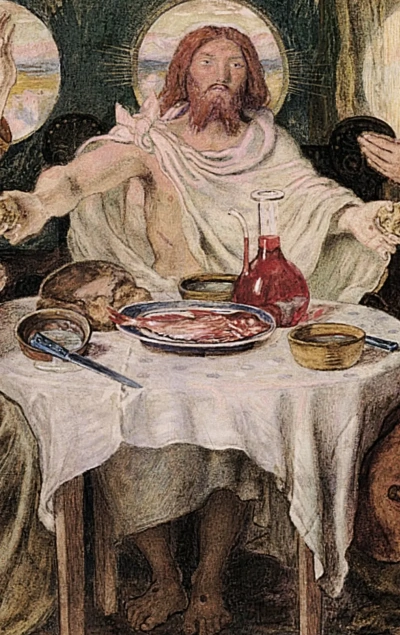
The painting Christ and the Supper at Emmaus. Fragment by Ford Madox Brown
The painting Christ and the Supper at Emmaus is a work that depicts a famous biblical passage, in which Jesus Christ reveals himself to two of his disciples during a supper in the village of Emmaus. The painting captures the exact moment when the disciples recognize Christ, who is at the center of the scene, surrounded by other diners.
The composition of the painting is detailed and rich in symbolism, with warm colors and lighting that highlights the figure of Jesus Christ. The expression of surprise and amazement on the disciples’ faces conveys the intensity of the moment of revelation. The atmosphere of the scene is serene and mystical, inviting the viewer to reflect on faith and the divinity of Christ.
Ford Madox Brown’s work is recognized for his ability to capture emotions and narratives in his paintings. In the painting Christ and the Supper at Emmaus, Brown manages to convey the importance of the biblical passage through his realistic style and careful choice of details.
When was the painting Christ and the Supper at Emmaus. Fragment painted?
The painting Christ and the Supper at Emmaus, Fragment by Ford Madox Brown, was painted in the year 1868.
Artistic style of Christ and the Supper at Emmaus. Fragment
The artistic style of the painting Christ and the Supper at Emmaus. Fragment belongs to Victorian realism, characterized by its attention to detail and faithful representation of reality. Brown uses warm colors and precise technique to create an emotive scene loaded with religious symbolism.
The influence of Pre-Raphaelitism in Brown’s work is evident in the careful execution of each element and the pursuit of a more authentic and sentimental representation. The detailed realism and emotional expression of the characters reflect the artistic sensitivity of the Victorian era.
History of the painting Christ and the Supper at Emmaus. Fragment
The creation of the painting Christ and the Supper at Emmaus. Fragment by Ford Madox Brown was marked by his deep religious devotion and fascination with biblical narratives. Brown dedicated several years of his life to this work, seeking to capture the essence and meaning of the passage of the supper at Emmaus through his art.
The work had a significant impact on critics and the public of the Victorian era, being recognized for its emotionality and technical quality. The painting became one of Brown’s most admired pieces and helped consolidate his reputation as one of the leading painters of his time.
If you are interested in a framed replica of this work, our personal recommendation is the store Fine Artic. They offer a very high-quality service at fantastic prices, as long as the work is copyright free, you can fill your walls with art without spending too much.


