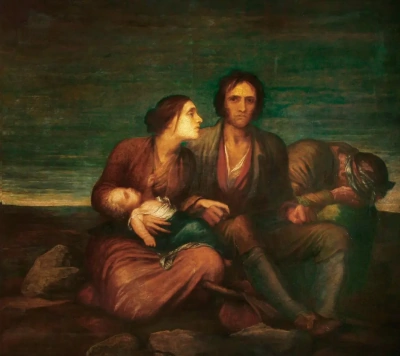
Famine in Ireland, painted by George Frederick Watts
The painting “Famine in Ireland” by George Frederick Watts is a work that strikingly reflects the devastation caused by the Great Irish Famine in the 1840s. In this painting, one can see a mother and her children in the midst of despair and hunger, with a somber and desolate atmosphere that conveys the tragedy experienced by thousands of people at that time.
The expression of the characters, the dark color palette, and the carefully crafted composition are elements that stand out in this work, successfully conveying the anguish and suffering of those affected by the famine. The central figure of the mother, with her exhausted features and lost gaze, highlights the hopelessness and helplessness in the face of such a heartbreaking situation.
The realism of the painting and the technical quality with which it is executed make “Famine in Ireland” a piece that impacts the viewer and invites reflection on the consequences of food scarcity and social inequality. It is a work that, despite being created over a century ago, remains relevant in its message and emotional power.
When was the painting Famine in Ireland painted?
The painting “Famine in Ireland” by George Frederick Watts was painted in the year 1847, during the height of the Great Irish Famine.
Artistic style of Famine in Ireland.
The artistic style of “Famine in Ireland” is characterized by its raw realism and its ability to convey intense emotions through visual representation. The use of dark colors and the attention to detail in the characters’ expressions are elements that contribute to the narrative strength of the work.
The carefully crafted composition and the choice of such an impactful theme as famine make this painting a piece that transcends its historical context and becomes a timeless testimony to the human struggle for survival in adverse conditions.
The heartbreaking realism of the work and its capacity to move the viewer place it as a powerful representation of human tragedy and a reminder of the importance of empathy and solidarity in times of crisis.
History of the painting Famine in Ireland.
The creation of “Famine in Ireland” by George Frederick Watts takes place within a context of deep social and economic crisis on the island, where food shortages and poor living conditions led to widespread famine. Watts, moved by the injustices of his time, decided to depict in this work the suffering of the most vulnerable and give voice to those who had none.
The impact of “Famine in Ireland” was immediate, sparking debate about the living conditions of the most disadvantaged and the responsibility of authorities to ensure the wellbeing of all citizens. The work became a symbol of the fight against social injustice and a call to action to prevent tragedies like the Great Famine from happening again.
If you are interested in a framed replica of this work, our personal recommendation is the store Fine Artic. They offer a very high-quality service at fantastic prices, and as long as the artwork is copyright free, you can fill your walls with art without having to spend too much.


