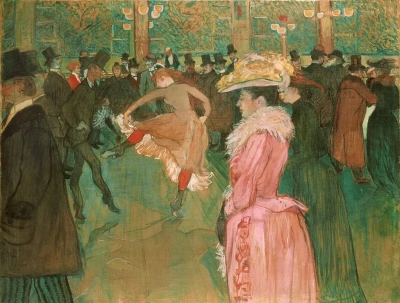
At the Moulin Rouge: the dance painted by Henri de Toulouse-Lautrec
In the painting At the Moulin Rouge: the dance, Henri de Toulouse-Lautrec captures the vibrant and bustling atmosphere of Parisian nightlife in the famous cabaret Moulin Rouge. The scene shows elegant couples dancing amidst the lively crowd, illuminated by the venue’s characteristic red light.
Toulouse-Lautrec’s loose brushwork and bold use of color combine to create a dynamic and energetic composition. The artist manages to convey the emotion and frantic rhythm of the music and dance, revealing his fascination with the bohemian life of the Belle Époque.
With his focus on the characters and bohemian atmosphere of the scene, Toulouse-Lautrec captures the very essence of the Moulin Rouge and late 19th-century Parisian society, making the viewer feel part of this effervescent night of fun and freedom.
When was the painting At the Moulin Rouge: the dance painted?
The painting At the Moulin Rouge: the dance was painted by Henri de Toulouse-Lautrec in the year 1890.
Artistic style of At the Moulin Rouge: the dance
The artistic style of At the Moulin Rouge: the dance falls within the Post-Impressionism movement, characterized by bold use of color, loose brushwork, and the depiction of modern and urban life.
Toulouse-Lautrec, influenced by his training in Impressionist painting and his interest in the bohemian world of Montmartre, developed a unique style that focuses on capturing the emotional and visual essence of Parisian Belle Époque, highlighting nightlife and characters of the era with a vibrant and expressive approach.
His focus on figures and the atmosphere of the scene, as well as his use of vivid and contrasting colors, make At the Moulin Rouge: the dance an iconic work that reflects the artist’s fascination with Parisian society of the time and his unique vision of nightlife.
History of the painting At the Moulin Rouge: the dance
The painting At the Moulin Rouge: the dance by Henri de Toulouse-Lautrec was created at a time when the artist was immersed in the bohemian and nocturnal life of Paris, frequenting places like the Moulin Rouge and portraying its inhabitants with a unique and personal style.
The work reflects Toulouse-Lautrec’s passion for urban life and the representation of the Belle Époque, showing his ability to capture the very essence of Parisian society of the time and convey it vibrantly and emotionally through his paintings.
If you are interested in a framed replica of this work, our personal recommendation is the store Fine Artic. They offer very high-quality service at fantastic prices; as long as the work is royalty-free, you can fill your walls with art without needing to spend too much.


