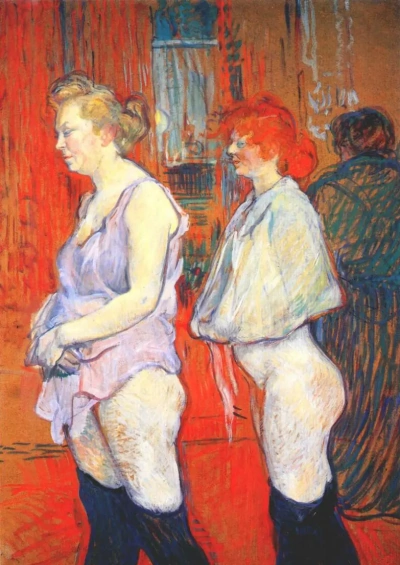
Rue des Moulins, the medical inspection by Henri de Toulouse-Lautrec
The painting Rue des Moulins, the medical inspection, painted by Henri de Toulouse-Lautrec, is a work that depicts a scene from a Parisian brothel in the post-impressionist era. The work shows several half-naked women waiting to be inspected by a doctor. In the decadent and sordid environment, the artist captures an atmosphere of decay and despair.
Toulouse-Lautrec uses dark and contrasting colors to highlight the harshness of the scene, with quick and expressive brushstrokes that add dynamism to the composition. The arrangement of the figures on different planes adds depth to the painting, while the lighting suggests an oppressive and gloomy atmosphere.
The artist manages to convey a feeling of desolation and helplessness through the gaze of the women in the painting, whose faces show resignation and sadness. Rue des Moulins, the medical inspection is a provocative work that questions the boundaries between beauty and decay, health and illness.
When was the painting Rue des Moulins, the medical inspection painted?
The painting Rue des Moulins, the medical inspection by Henri de Toulouse-Lautrec was painted in the 1890s.
Artistic style of Rue des Moulins, the medical inspection
Rue des Moulins, the medical inspection by Toulouse-Lautrec falls within the post-impressionist style, characterized by bold use of color and experimentation with light and form. The artist employs an innovative technique of loose and vigorous brushstrokes, allowing him to capture the emotional essence of the scene in a striking way. The dynamic composition and expressive use of color contribute to the dramatic intensity of the work, creating a powerful impression on the viewer.
History of the painting Rue des Moulins, the medical inspection
The creation of Rue des Moulins, the medical inspection by Toulouse-Lautrec is surrounded by controversy and intrigue. It is said that the inspiration for the work came from the artist’s own experiences in Parisian brothels, which he frequented. The painting reflects the harshness of Parisian nightlife at that time, as well as the difficult conditions in which the portrayed women lived. This work had a significant impact on the society of the time by questioning established social and moral norms and challenging the hypocrisy of bourgeois society.
If you are interested in a framed replica of this work, our personal recommendation is the store Fine Artic. They offer a very high-quality service at fantastic prices, as long as the work is rights-free, you can fill your walls with art without needing to spend too much.


