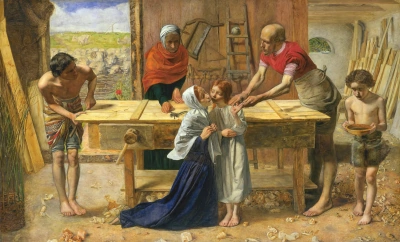
Christ in the House of His Parents by John Everett Millais
The painting “Christ in the House of His Parents” painted by John Everett Millais is a work that depicts Jesus as a child alongside his parents, Mary and Joseph, in the latter’s carpentry workshop. The painting is characterized by its detailed realism and the expression of the characters, which convey deep emotion to the viewer.
The work shows Jesus being comforted by his mother after a hand injury while Joseph looks on worriedly. The details of the scene, such as the carpentry tools, the characters’ gestures, and the lighting, bring the narrative represented in the painting to life.
“Christ in the House of His Parents” is considered one of Millais’ masterpieces and has been the subject of analysis and admiration by critics and art experts since its creation.
When was the painting “Christ in the House of His Parents” painted?
The painting “Christ in the House of His Parents” by John Everett Millais was painted in the year 1849.
Artistic style of “Christ in the House of His Parents”
The artistic style of “Christ in the House of His Parents” falls within Victorian realism, characterized by its attention to detail and faithful representation of reality. Millais manages to capture an everyday scene with a high degree of precision and emotion, capturing the humanity of the characters and their emotions in a moving way.
Millais’ technique in this work reflects his ability to combine meticulous representation of elements with an artistic sensitivity that transcends the purely visual, creating a deep connection between the work and the viewer through the expression and gestures of the characters.
History of the painting “Christ in the House of His Parents”
The creation of the painting “Christ in the House of His Parents” by John Everett Millais was influenced by his deep religious devotion and his interest in depicting biblical scenes in an innovative way. The work had a significant impact on the criticism of the time, which praised the artist’s skill at conveying emotions through painting and his mastery in the use of light and color.
The depiction of Jesus as a vulnerable and human child, comforted by his mother, broke with the traditional stereotypes of religious iconography, offering a closer and more human view of the figure of Christ. This reinterpretation of the biblical theme contributed to the consolidation of Victorian realism as an influential artistic movement at the time.
If you are interested in a framed replica of this work, our personal recommendation is the store Fine Artic. They offer a very high-quality service at fantastic prices, provided the work is royalty-free, allowing you to fill your walls with art without spending too much.


