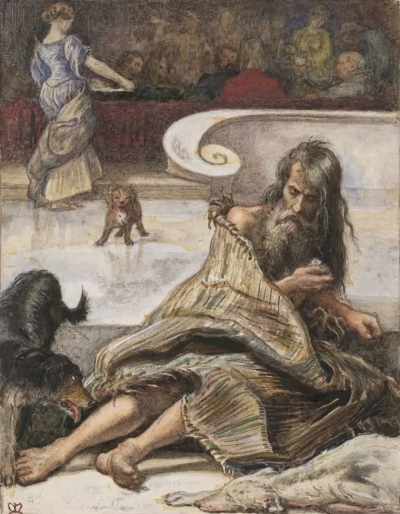
The Rich Man and Lazarus painted by John Everett Millais
The painting The Rich Man and Lazarus painted by John Everett Millais depicts a biblical scene illustrating Jesus’ parable about a rich man and a beggar named Lazarus. The painting shows the rich man enjoying luxury while Lazarus lies at his doorstep, longing to eat the crumbs that fall from his table.
The composition of the painting stands out for its contrast between the opulence of the rich man and the extreme poverty of Lazarus. The colors used by Millais reinforce this dichotomy, creating an atmosphere of loneliness and despair in the figure of the beggar. The facial expression of each character reflects their social and spiritual position in the biblical narrative.
The work provokes reflection on the moral responsibility to help the less fortunate and the consequences of indifference toward the suffering of others. Through his visual representation, Millais invites the viewer to question their own attitudes toward charity and empathy.
When was the painting The Rich Man and Lazarus painted?
The painting The Rich Man and Lazarus by John Everett Millais was painted in the year 1886.
Artistic style of The Rich Man and Lazarus
The artistic style of The Rich Man and Lazarus by John Everett Millais is framed within Victorian realism, characterized by its meticulous attention to detail and faithful representation of social reality.
Millais employs a detailed technique in the painting, accurately capturing the facial expressions and gestures of the characters. The use of light and shadow highlights the class differences between the rich man and Lazarus, contributing to the visual narrative of the parable.
Millais’ work reflects his commitment to honest representation of everyday life and his interest in exploring themes of social justice and morality through art. The realism of The Rich Man and Lazarus invites reflection on social inequalities and human solidarity.
History of the painting The Rich Man and Lazarus
The painting The Rich Man and Lazarus de John Everett Millais was commissioned by a private collector as part of a series of paintings based on biblical passages. The work caused a great impact in the Victorian era, provoking debates about charity, wealth, and social responsibility.
The visual representation of Jesus’ parable attracted the attention of critics and spectators, who praised Millais’ skill in conveying emotions through painting. The painting became an emblematic piece of Victorian realism and remains a subject of study and admiration today.
If you are interested in a framed replica of this work, our personal recommendation is the store Fine Artic. They offer a very high-quality service at fantastic prices, and as long as the work is royalty-free, you can fill your walls with art without needing to spend too much.


