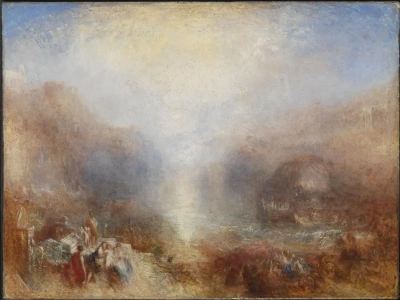
The painting Mercury commanding Aeneas painted by Joseph Mallord William Turner
Mercury commanding Aeneas is a work that shows Mercury, the messenger of the gods in Roman mythology, addressing Aeneas, a Trojan hero, to remind him of his destiny and guide him on his journey. The painting captures the interaction between the two characters in a tumultuous seascape, reflecting the tension and importance of the moment. Turner manages to depict a scene full of drama and mysticism, characteristic of his romantic style.
The painting focuses on the imposing figure of Mercury, highlighting his divine presence and his role as a spiritual guide to Aeneas. The light and atmosphere created by Turner contribute to the visual narrative, emphasizing the connection between the earthly and the transcendental. The composition and coloring provide a sense of movement and energy, bringing the scene to life.
The work Mercury commanding Aeneas is an outstanding example of Turner’s talent for capturing the essence of mythology and nature through his unique artistic approach. His masterful handling of light and composition elevates the painting to a level of emotional and symbolic expression, leaving a lasting impression on the viewer.
When was the painting Mercury commanding Aeneas painted?
The painting Mercury commanding Aeneas by Joseph Mallord William Turner was painted in the year 1801.
Artistic style of Mercury commanding Aeneas
The artistic style of Mercury commanding Aeneas reflects the influence of romanticism in Turner’s work, with its focus on the emotional, the mystical, and the sublime. The depiction of mythological figures in a natural and atmospheric setting shows the artist’s ability to create an evocative and meaningful atmosphere.
The vibrant color palette and Turner’s loose, expressive brushwork contribute to the sense of movement and drama in the work, highlighting the significance of the moment depicted. The use of light and shadow to enhance contrasts and textures adds depth and mystery to the scene, creating a striking visual experience for the viewer.
In Mercury commanding Aeneas, Turner merges mythological narrative with his personal artistic vision, creating a work that transcends the purely descriptive to explore universal themes such as destiny, spiritual guidance, and the struggle between the human and the divine.
History of the painting Mercury commanding Aeneas
The creation of the painting Mercury commanding Aeneas by Joseph Mallord William Turner was marked by the artist’s fascination with classical mythology and his quest for emotional expression through painting. It is said that Turner was inspired by reading ancient texts about the story of Aeneas and his encounter with Mercury, finding in this narrative the opportunity to explore fundamental themes of the human condition.
The impact of Mercury commanding Aeneas in the art world was significant, as it solidified Turner’s reputation as one of the great masters of romanticism. The work was admired for its stylistic innovation and its ability to convey the intensity of the moment represented, becoming a reference for later generations of artists who sought to explore the sublime and the transcendental in their works.
If you are interested in a framed replica of this work, our personal recommendation is the store Fine Artic. They offer a very high-quality service at fantastic prices; as long as the work is free of rights you can fill your walls with art without having to spend too much.


