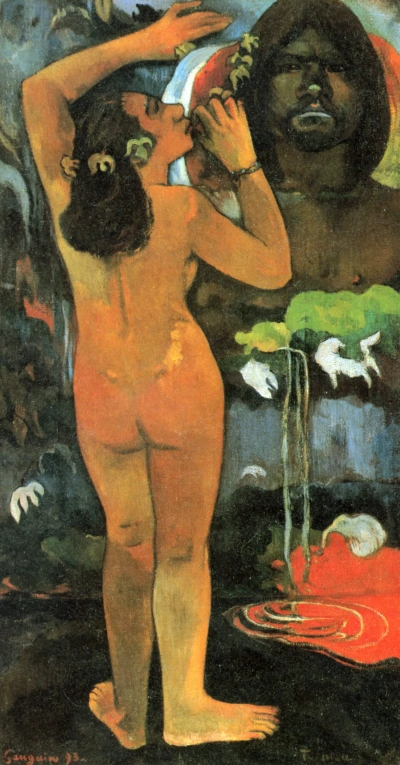
The painting Hina, goddess of the moon and Te Fatu, the spirit of the earth by Paul Gauguin
The painting “Hina, goddess of the moon and Te Fatu, the spirit of the earth” depicts a Polynesian mythological scene showing the goddess Hina, personification of the moon, accompanied by Te Fatu, the spirit of the earth. Gauguin captures the mystical essence of Polynesian culture through vibrant colors and symbolic forms.
The painting conveys a sense of spiritual connection between humans and nature, highlighting the importance of the moon and the earth in the worldview of these peoples. Gauguin manages to capture the magical and enigmatic atmosphere of Polynesian mythology, inviting the viewer to reflect on the relationship between human beings and their environment.
Through the combination of figurative and abstract elements, Gauguin creates a work that transcends mere representation to delve into the symbolic and spiritual, exploring universal themes such as connection with the divine and nature.
When was the painting Hina, goddess of the moon and Te Fatu, the spirit of the earth painted?
The painting “Hina, goddess of the moon and Te Fatu, the spirit of the earth” by Paul Gauguin was painted in the year 1893.
Artistic style of Hina, goddess of the moon and Te Fatu, the spirit of the earth
The artistic style of “Hina, goddess of the moon and Te Fatu, the spirit of the earth” by Gauguin is characterized by the combination of intense colors and mythological symbolism, reflecting the influence of Polynesian culture on his work. Gauguin approaches spiritual and metaphysical themes through a primitivist and symbolist aesthetic, seeking to transcend the merely visual to convey a deep and transcendent message.
Gauguin’s technique is characterized by expressive brushstrokes and an unconventional composition that emphasizes abstraction and the artist’s personal interpretation of reality. His style aims to evoke emotions and awaken the viewer’s imagination, inviting them to immerse themselves in a world of hidden meanings and mysteries to discover.
History of the painting Hina, goddess of the moon and Te Fatu, the spirit of the earth
The painting “Hina, goddess of the moon and Te Fatu, the spirit of the earth” by Paul Gauguin was created during his stay in Tahiti, where he was inspired by local beliefs and mythologies to bring this work to life. Gauguin sought to capture the spiritual and mystical essence of Polynesian culture, exploring the connection between human beings and nature through his divine characters.
Gauguin’s painting had a significant impact on art history, marking a milestone in the representation of non-Western themes in European painting. His exotic and mystical vision of Polynesian mythology helped enrich the artistic repertoire of the era, opening new doors to the exploration of regional cultures and symbolisms in Western painting.
If you are interested in a framed replica of this work, our personal recommendation is the store Fine Artic. They offer a very high-quality service at fantastic prices, as long as the work is rights-free you can fill your walls with art without having to spend too much.


