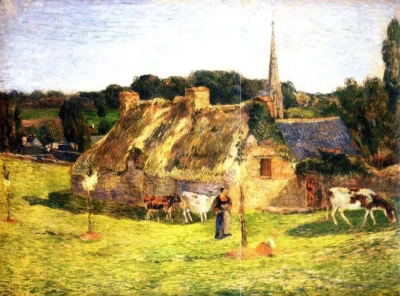
The painting Field of Lolichon and the Church in Pont-Aven painted by Paul Gauguin
The painting Field of Lolichon and the Church in Pont-Aven is an iconic work by the French artist Paul Gauguin. This painting shows a countryside scene with a church in the background, characteristic of Gauguin’s works during his period in Pont-Aven.
The combination of vibrant colors and bold brushstrokes characterize Gauguin’s distinctive style in this work. The composition and perspective in Field of Lolichon and the Church in Pont-Aven reflect Gauguin’s influence by primitive art and his quest for personal expression.
The depiction of nature and architecture in this painting reveals Gauguin’s fascination with the beauty of rural life and his desire to escape modernity of his time. Field of Lolichon and the Church in Pont-Aven is an outstanding example of Gauguin’s artistic legacy in post-impressionism.
When was the painting Field of Lolichon and the Church in Pont-Aven painted?
The painting Field of Lolichon and the Church in Pont-Aven by Paul Gauguin was painted in the year 1888.
Artistic style of Field of Lolichon and the Church in Pont-Aven
The artistic style of Field of Lolichon and the Church in Pont-Aven reflects the influence of post-impressionism, with bold colors and an unconventional interpretation of reality. Gauguin experiments with form and color to create a symbolic and emotional representation of nature and architecture.
History of the painting Field of Lolichon and the Church in Pont-Aven
The history behind the painting Field of Lolichon and the Church in Pont-Aven by Paul Gauguin centers on his time in the artistic community of Pont-Aven, where he sought inspiration in rural life and local culture. This work represents his search for personal expression and his rejection of the artistic conventions of the time, marking a milestone in his career as an artist.
If you are interested in a framed replica of this work, our personal recommendation is the store Fine Artic. They offer a very high-quality service at fantastic prices, as long as the work is free of rights, you can fill your walls with art without having to spend too much.


