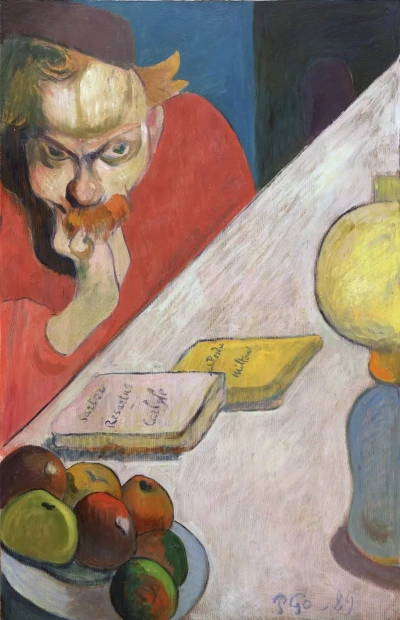
Portrait of Meyer de Haan, by Lamplight
The painting Portrait of Meyer de Haan, by Lamplight painted by Paul Gauguin is a work that shows a male figure seated in a dark environment lit by a lamp. Gauguin uses dark and contrasting colors to highlight the figure in the foreground, creating a mysterious and melancholic atmosphere.
The pose of the character and the dramatic lighting suggest a sense of introspection and solitude. The use of thick and textured brushstrokes adds depth to the work, bringing a sense of movement and life to the static figure.
The combination of symbolic elements and Gauguin’s distinctive technique make this painting an intriguing piece that invites reflection on human nature and universal emotions.
When was the painting Portrait of Meyer de Haan, by Lamplight painted?
The painting Portrait of Meyer de Haan, by Lamplight by Paul Gauguin was painted in the year 1889.
Artistic style of Portrait of Meyer de Haan, by Lamplight
The work Portrait of Meyer de Haan, by Lamplight by Paul Gauguin represents an example of the post-impressionist style of the French artist. Gauguin moved away from traditional artistic conventions to explore vivid colors and simplified forms, seeking to express emotions and deep meanings through his art.
In this particular work, Gauguin demonstrates his mastery in the use of color and light to create an atmosphere full of emotions and symbolism. His unique technique and focus on existential themes make this work a notable example of Gauguin’s style and his contribution to modern art.
History of the painting Portrait of Meyer de Haan, by Lamplight
The story behind Portrait of Meyer de Haan, by Lamplight by Paul Gauguin centers on the artist’s relationship with his friend Meyer de Haan, whom he portrayed in this painting. The work reflects the deep friendship between them and the mutual influence in their respective artistic careers.
Gauguin found in De Haan a source of inspiration and support, which is reflected in the intimacy and emotion of the portrait. The work has been interpreted as a symbolic representation of friendship and companionship, making it a testament to the personal connection between both artists.
If you are interested in a framed replica of this work, our personal recommendation is the store Fine Artic. They offer a very high-quality service for fantastic prices, and as long as the work is copyright-free, you can fill your walls with art without having to spend too much.


