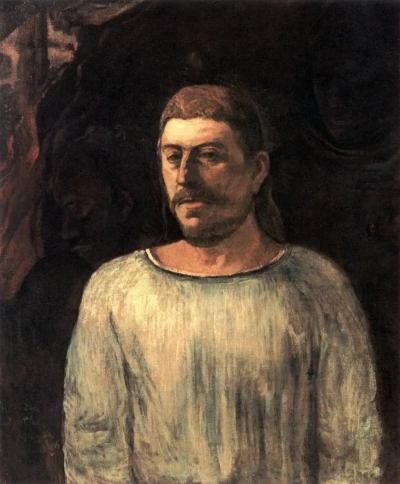
Self-portrait “On the Calvary” by Paul Gauguin
The painting Self-portrait “On the Calvary” painted by Paul Gauguin shows the artist with a serious and contemplative expression, surrounded by religious symbols and references to his personal life. Gauguin depicts himself in the middle of a somber and symbolic landscape, with intense colors and a style that reflects his spiritual quest and internal struggle to find meaning in his art.
The composition of the painting is complex, with elements that suggest a deep emotional conflict in the artist. Warm and cool colors blend in an unsettling way, creating an atmosphere of mystery and melancholy. Gauguin’s penetrating gaze seems to challenge the viewer, inviting them to reflect on life, death, and the search for meaning in a turbulent world.
En Self-portrait “On the Calvary”, Gauguin manages to convey a sense of introspection and transcendence, exploring universal themes through a personal and emotive representation. The work invites contemplation of the complexity of the human being, their relationship with the divine, and their search for transcendence in a materialistic and chaotic world.
When was the painting Self-portrait “On the Calvary” painted?
The painting Self-portrait “On the Calvary” by Paul Gauguin was painted in the year 1889.
Artistic style of Self-portrait “On the Calvary”
The artistic style of Self-portrait “On the Calvary” is characterized by the presence of intense colors, religious symbols, and a personal and emotive representation of the artist. Gauguin uses expressionist brushstrokes and a symbolic composition to convey his unique vision of the world and his spiritual quest.
His style departs from the conventions of impressionism and ventures into more personal and spiritual realms, exploring deep and existential themes through a color palette rich in contrasts and a symbolic and enigmatic composition.
The work falls within post-impressionism, but with influences from symbolism and primitive art, creating a unique fusion of styles and perspectives that bring to life a work full of meaning and emotion.
History of the painting Self-portrait “On the Calvary”
The painting Self-portrait “On the Calvary” by Paul Gauguin was created at a time of deep personal and creative crisis for the artist. The work reflects his internal conflicts, his spiritual quest, and his obsession with finding a deeper meaning in his art.
Gauguin immerses himself in a symbolic and mysterious world, where every detail of the composition has a hidden and personal meaning. The creation of the work was an intense and painful process for the artist, reflected in the emotional intensity of the painting and its powerful visual presence.
If you are interested in a framed replica of this work, our personal recommendation is the store Fine Artic. They offer a very high-quality service at fantastic prices; as long as the artwork is rights-free, you can fill your walls with art without having to spend too much.


