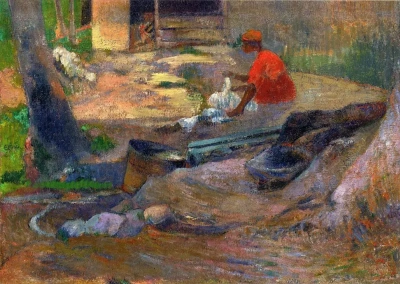
The Little Washerwoman by Paul Gauguin
The Little Washerwoman is a work painted by the French artist Paul Gauguin, known for his innovative style in Post-Impressionist art. This painting shows a young washerwoman in the foreground, with a lush and colorful landscape in the background.
The composition of the work is characterized by the simplification of forms and the intensity of colors, typical of Gauguin’s style. The figure of the washerwoman stands out for her firm posture and serene gaze, while the landscape blends into a combination of vibrant tones.
Gauguin manages to create a mysterious and evocative atmosphere in The Little Washerwoman, where the human figure fully integrates into its natural environment, reflecting the harmonious relationship the artist sought between human beings and nature.
When was the painting The Little Washerwoman created?
The Little Washerwoman by Paul Gauguin was painted in the year 1888.
Artistic style of The Little Washerwoman
The artistic style of The Little Washerwoman reflects the influence of Post-Impressionism and Symbolism in Gauguin’s work. Its intense colors, simplified forms, and the fusion between the human figure and nature are distinctive characteristics of his style.
Gauguin moved away from the artistic conventions of his time to explore new forms of visual representation, seeking to capture the spiritual and emotional essence of his subjects. The Little Washerwoman is an example of how the artist manages to convey a feeling of harmony and mystery through the combination of colors and forms.
Gauguin’s work, including The Little Washerwoman, has been recognized for its originality and its contribution to the development of modern art, influencing subsequent generations of artists.
History of the painting The Little Washerwoman
The Little Washerwoman by Paul Gauguin was created during his stay on the island of Martinique, where the artist sought inspiration in the lush tropical nature and the daily life of the local inhabitants. The work reflects Gauguin’s fascination with the island’s culture and natural beauty, as well as his interest in exploring new forms of artistic representation.
Although The Little Washerwoman was not widely recognized in its time, it has over time become one of Gauguin’s most emblematic works, highlighting his ability to combine formal experimentation with a deep exploration of universal themes like the relationship between humans and their environment.
If you are interested in a framed replica of this work, our personal recommendation is the store Fine Artic. They offer a very high quality service at fantastic prices; as long as the work is copyright-free, you can fill your walls with art without needing to spend too much.


