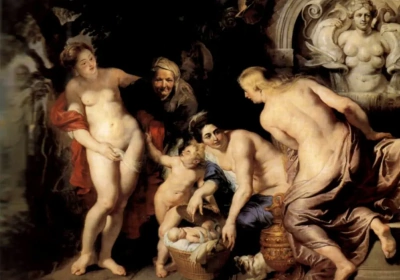
Baby Erichthonius, or the curiosity of the king’s daughters had been buried by Peter Paul Rubens
The painting Baby Erichthonius, or the curiosity of the king’s daughters had been buried, painted by Peter Paul Rubens, is a work that shows the mythological story of the daughters of Cecrops, king of Athens, who opened the basket containing the newborn Erichthonius, son of Hephaestus and Athena. The painting depicts this crucial moment, where the daughters’ curiosity leads to the baby’s revelation.
In the work, Rubens captures the tension on the faces of the king’s daughters as they discover the secret kept in the basket. The vibrant colors and dynamic composition reflect the moment of discovery and the guilt the daughters will feel for their action.
The representation of the myth of Baby Erichthonius in Rubens’ hands demonstrates his mastery in capturing emotions and mythological narratives, creating a powerful and moving image that has endured over the years.
When was the painting Baby Erichthonius, or the curiosity of the king’s daughters had been buried painted?
The painting Baby Erichthonius, or the curiosity of the king’s daughters had been buried by Peter Paul Rubens was painted in the year 1616.
Artistic style of Baby Erichthonius, or the curiosity of the king’s daughters had been buried
The artistic style of the painting Baby Erichthonius, or the curiosity of the king’s daughters had been buried by Peter Paul Rubens is characterized by its focus on the emotional and dramatic representation of mythological scenes. Rubens uses vivid colors and a dynamic composition to bring the myth’s narrative to life, highlighting the emotional intensity of the depicted characters.
His masterful technique and ability to capture human expression and gesture are reflected in this work, offering the viewer a striking and immersive visual experience.
History of the painting Baby Erichthonius, or the curiosity of the king’s daughters had been buried
The painting Baby Erichthonius, or the curiosity of the king’s daughters had been buried by Peter Paul Rubens is a work that has fascinated viewers and critics since its creation. Its impact lies in how Rubens conveys the emotion and drama of the mythological story through his visual representation.
The creation of this work may have been influenced by the artistic and cultural trends of Rubens’ time, as well as by his own passion for mythology and visual narrative. His legacy endures in this work, which continues to be appreciated as a unique expression of Rubens’ artistic genius.
If you are interested in a framed replica of this work, our personal recommendation is the store Fine Artic. They offer a very high-quality service at fantastic prices; as long as the work is copyright-free, you can fill your walls with art without needing to spend too much.


