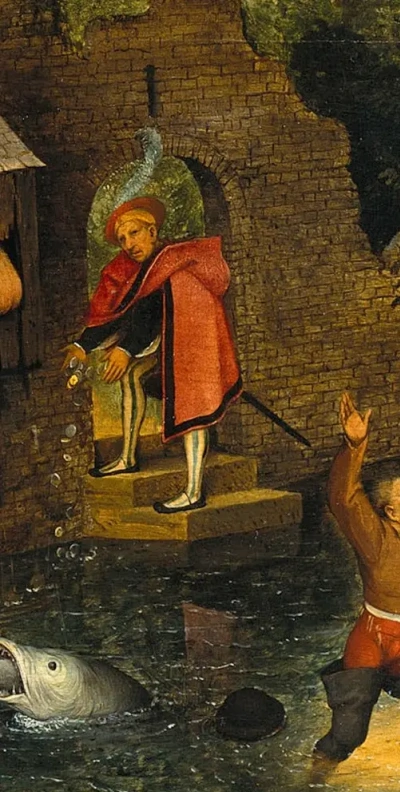
Flemish Proverbs. Segment: to throw (someone’s) money into the water – to waste (someone’s) money by Pieter Bruegel The Elder
The painting Flemish Proverbs by Pieter Bruegel The Elder is a work that depicts everyday scenes with a moral and satirical background. In this painting, the popular expression “to throw money into the water – to spend painted money” is shown, alluding to wasting resources unnecessarily or in vain.
Bruegel uses his characteristic and detailed style to represent a crowd of characters performing various activities, while symbolic and allegorical elements are interwoven in the composition to convey profound messages about human nature and its actions.
The work invites the viewer to reflect on the meaning of the actions depicted and to discover the multiple layers of interpretation hidden in every corner of the canvas, thus achieving a unique connection with the work and its timeless message.
When was the painting Flemish Proverbs. Segment: to throw (someone’s) money into the water – to waste (someone’s) money?
The painting Flemish Proverbs by Pieter Bruegel The Elder painted? It was painted in the year 1559 during the Flemish Renaissance.
Artistic style of Flemish Proverbs. Segment: to throw (someone’s) money into the water – to waste (someone’s) money
The artistic style of Flemish Proverbs by Pieter Bruegel The Elder is characterized by his ability to combine the depiction of realistic scenes with symbolic and allegorical elements, creating a complex visual narrative rich in meaning.
Bruegel stands out for his meticulousness in depicting details, as well as for the psychological depth of his characters and his ability to convey emotions and messages through the composition and technique used in the work.
His unique style and focus on the customs and daily life of the time have earned him recognition as one of the masters of 16th-century Flemish art.
History of the painting Flemish Proverbs. Segment: to throw (someone’s) money into the water – to waste (someone’s) money
The painting Flemish Proverbs by Pieter Bruegel The Elder has been the subject of study and admiration since its creation, standing out for its originality and moralizing content. Throughout the centuries, it has been interpreted in different ways and has inspired artists and viewers to reflect on human nature.
The history of this work is framed in the cultural and social context of the Flemish Renaissance, where Bruegel stood out for his focus on popular and customary themes, using art as a means to educate and entertain his audience.
If you are interested in a framed replica of this work, our personal recommendation is the store Fine Artic. They offer a very high-quality service at fantastic prices; as long as the work is royalty-free, you can fill your walls with art without spending too much.


