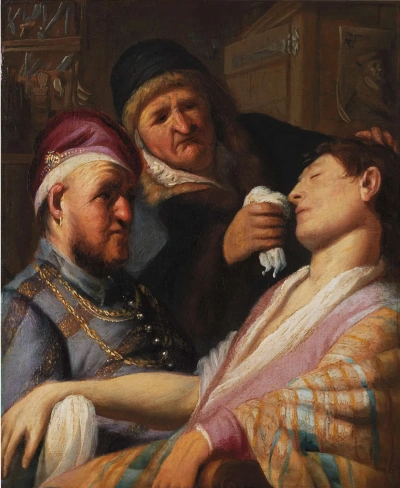
Unconscious Patient (Sense of Smell) – Rembrandt Harmenszoon van Rijn
The painting “Unconscious Patient” shows a man lying in bed with a medical assistant holding a vial of salts to revive the senses. The scene focuses on the sense of smell and the patient’s reaction upon awakening.
Rembrandt captures the tension in the man’s facial expression and the detailed attention to the doctor’s hands. The dramatic lighting highlights the atmosphere of mystery and wonder in the room.
The painting invites the viewer to reflect on the fragility of life and the importance of the senses in our perception of the surrounding world. The work is a masterful example of Rembrandt’s realism and technical mastery in portraying everyday scenes.
When was the painting Unconscious Patient (Sense of Smell) painted?
The painting “Unconscious Patient (Sense of Smell)” by Rembrandt Harmenszoon van Rijn was painted in the 17th century, during the Baroque period in the Netherlands.
Artistic style of Unconscious Patient (Sense of Smell)
The artistic style of “Unconscious Patient (Sense of Smell)” reflects the influence of realism and the masterful use of light and shadow characteristic of Dutch Baroque. Rembrandt manages to convey emotions and create intense atmospheres through his unique painting technique.
His attention to detail in depicting facial expressions and the carefully planned composition highlight his skill in capturing humanity in his works. This combination of realism and drama defines Rembrandt’s distinctive artistic style in “Unconscious Patient (Sense of Smell)”.
History of the painting Unconscious Patient (Sense of Smell)
The creation of the painting “Unconscious Patient (Sense of Smell)” by Rembrandt is surrounded by mystery and speculation. It is said that the work was commissioned by a doctor seeking to represent the importance of the senses in diagnosing and treating illnesses during the period.
The impact of this painting on society at the time was significant, as it reflects the medical beliefs and practices of the era. Through this work, Rembrandt captured the essence of medicine and human fragility in a single image, leaving a lasting legacy in art history.
If you are interested in a framed replica of this work, our personal recommendation is the store Fine Artic. They offer a very high-quality service at fantastic prices as long as the artwork is copyright-free, allowing you to fill your walls with art without spending too much.


