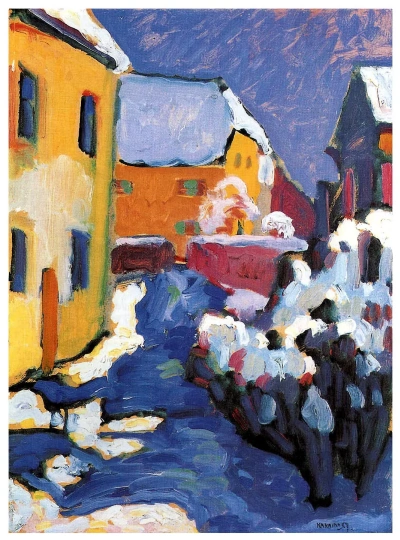
Cemetery and Vicarage in Kochel, painted by Wassily Kandinsky
Cemetery and Vicarage in Kochel is a work of art by the Russian painter Wassily Kandinsky. This painting, dating from the early 20th century, is known for its abstract representation of an urban landscape. Kandinsky, one of the pioneers of abstract art, used vibrant colors and geometric shapes in this work to convey emotions and sensations.
The painting shows a cemetery and a church in the Bavarian village of Kochel, where Kandinsky lived for a time. Although the elements of the landscape are recognizable, the artist transforms them into an abstract composition full of movement and energy. The combination of contrasting colors and stylized shapes creates a mysterious and evocative atmosphere.
Cemetery and Vicarage in Kochel reflects Kandinsky’s exploration of the abstract world, where conventional forms dissolve into a dance of lines and colors. This work is an early example of the artist’s innovative approach to painting and his quest for a unique and expressive visual language.
When was the painting Cemetery and Vicarage in Kochel painted?
The painting Cemetery and Vicarage in Kochel was painted by Wassily Kandinsky in the early 20th century, around 1908-1909.
Artistic style of Cemetery and Vicarage in Kochel
The work Cemetery and Vicarage in Kochel exhibits a unique and avant-garde artistic style, characterized by the abstraction of forms and colors. Kandinsky, as a pioneer of abstract art, moves away from traditional figurative representation and seeks to express emotions and experiences through the combination of unconventional visual elements.
In this painting, Kandinsky uses bright and contrasting colors, as well as stylized geometric shapes, to create a landscape that transcends tangible reality and enters a world of abstraction and fantasy. The work reflects the influence of Expressionism and Symbolism in the artist’s work, as well as his interest in exploring new forms of visual representation.
History of the painting Cemetery and Vicarage in Kochel
The painting Cemetery and Vicarage in Kochel by Wassily Kandinsky was one of the first works in which the artist experimented with abstraction and simplification of forms. During his stay in Kochel, Kandinsky was inspired by the landscapes and architecture of the region, which is reflected in this painting.
The creation of this work marked a turning point in Kandinsky’s career, as he explored new avenues of artistic expression and broke with established conventions. Cemetery and Vicarage in Kochel became a reference point for abstract art and a milestone in the evolution of visual language in the 20th century, influencing subsequent generations of artists and viewers.
If you are interested in a framed replica of this work, our personal recommendation is the store Fine Artic. They offer a very high-quality service at fantastic prices, and as long as the work is copyright-free you can fill your walls with art without spending too much.


